
RSOP : a new service to help reduce the risk of overdose in Québec
Drugs: Help and Referral is launching a new remote service for overdose prevention, known ...
Read moreIs drug use solely a man issue? For decades, there was a belief that women used drugs far less than men. At that time, the majority of researchers—mostly men—focused their studies on male drug consumption. Female researchers gradually developed more inclusive studies, but their findings were often ignored or downplayed in academic publications, primarily led by men.
Over time, with the increasing presence of women in academia, research has shown that women do consume drugs, and much more than previously thought. Today, while statistics still show some differences between men and women, these differences are sometimes minimal and the gap is narrowing. However, women remain largely underrepresented in addiction treatment pathways. Why is that?
More and more, drug addiction is viewed as a public health issue rather than a criminal one. Despite this, a strong stigma against people who use drugs persists. This stigma manifests in three different forms :
These three forms of stigma can have major consequences for anyone who uses drugs. However, it is observed that these are even stronger among the women population. In a 2023 Franco-Quebec study, they reported that “being a woman is associated with high expectations and pressures related to, for example, their parental responsibilities and physical appearance. “
Indeed, the weight of parenthood falls more heavily on women’s shoulders. Regardless of their personal choices, women are still systematically associated—or even reduced—to the role of motherhood. The role of a mother is seen as incompatible with substance use, fueling strong social stigma. Some mothers even refrain from discussing their drug use with healthcare professionals for fear of losing custody of their children.
There is a direct link between the stigma faced by drug users and their access to appropriate care pathways. It is a difficult cycle to break: the stronger the social stigma, the more self-stigma and shame are reinforced. The more shame builds up, the less likely people are to seek help. The less help is sought, the less healthcare services adapt, and the further the process of destigmatization recedes.
These inadequate services then fuel distrust of the system among women. A recent study highlighted “the importance of feeling in a safe space that would allow them to disclose sensitive experiences, for example, related to trauma.”

Shame and distrust add to other barriers in accessing care, particularly those stemming from persistent gender inequality in society. We know that, even today, women are more likely to have lower incomes than men, hold precarious jobs, have more family responsibilities, and make up the majority of single-parent families. All these factors make access to care much more difficult, even when a call for help has been made.
This minority presence of women in various care pathways also makes it harder to evaluate the effectiveness of programs and their ability to meet their specific needs. Furthermore, research projects encounter difficulties in recruiting female participants who have entered a treatment pathway, for similar reasons related to distrust. Yet, these research projects are crucial to identify the specific needs of certain populations and better address them.
Addressing the issue of stigma specific to women is a step in the right direction. The various studies mentioned above, some of which are very recent, demonstrate the research community’s interest in better understanding this reality. Although much remains to be done, these efforts will help guide healthcare and social service systems towards more inclusive practices for women, as well as for people of diverse gender identities.
At Drugs: Help and Referral, we observe that the proportion of women using our service is higher than their actual representation in addiction care pathways. Karine Bertrand, invited to speak at our 2023 fundraising event, sees this as a sign that the confidentiality of our service, as well as its entirely remote intervention mode, make it a serious and effective option for addressing the needs of female drug users and combating stigma.
Proportion of Men and Women in Various Addiction Care Services
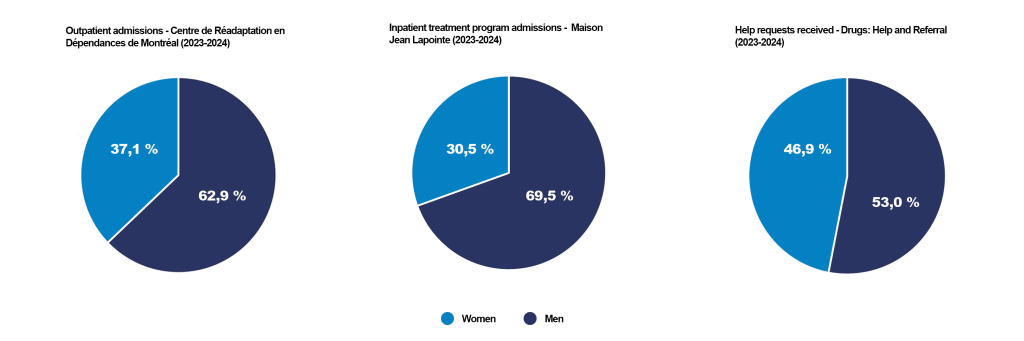
The above diagrams provide an overview of the underrepresentation of women in certain treatment pathways, compared to the near parity in the volume of help requests received by our services. These figures are presented as examples and do not question the quality of care provided to women in these services, nor their capacity to accommodate more women.
This is also a good opportunity to remind that our services are available for free, 24/7, throughout Quebec:
Contact us by phone at 1-800-265-2626 or via chat at the bottom right of your screen. Our team offers listening, support, information, and referrals.
Ce contenu a été traduit grâce au soutien du Secrétariat aux relations avec les Québécois d’expression anglaise.
Drugs: Help and Referral is launching a new remote service for overdose prevention, known ...
Read more