
RSOP : a new service to help reduce the risk of overdose in Québec
Drugs: Help and Referral is launching a new remote service for overdose prevention, known ...
Read moreWhen we wish to change our substance use habits, it can be useful to have a clear picture of the effects and consequences using can have on our lives. For that, we can use a tool that has been recognized: the decisional balance.
The decisional balance is a tool that can be used in many situations that require making important decisions: professional, personal, investments or any other big life changes.
When it comes to substance use, many important decisions, at many stages during a process of change, may be worth taking the time to think them through. Here are some examples:
The decisional balance aims at comparing the benefits/pros and costs/cons of two situations:
At first, it may be surprising to make a list of the benefits/pros of continuing to use. However, they do exist, and it is important to identify them.
« People would not use if there were no benefits to doing so » explains David Galipeau, Counselor at Drugs: help and Referral. « But they may be in denial about the consequences. This tool helps to see the whole situation. […] The person becomes more objective about their situation and takes some distance. They can then concretely see what is standing in the way of enacting change. »
Below is an example of a decisional balance that could be done by someone wanting to stop using:
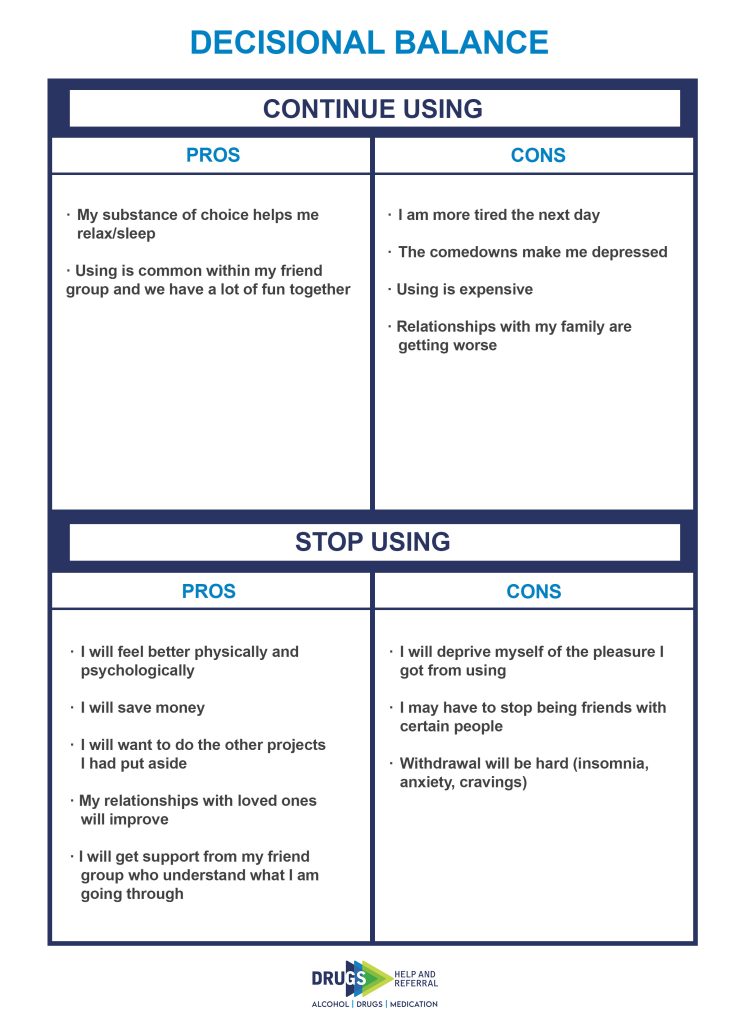
Thanks to this exercise, anyone wanting to make changes can clearly see:
Of course, it is up to each person to make their own list of pros and cons which may be different from the ones above. Their goals may be different as well: some people can use the decisional balance to stop completely and others to cut down. Here too, the pros and cons of each person will be different.
To do the decisional balance exercise, you can either download and print our model or simply do it on a sheet of paper.
The decisional balance is an exercise among others used to cut back or completely stop using. If you need help defining strategies for changing that are suited to your situation, please contact our team of counselors at 1-800-265-2626 or chat, bottom right of screen. It is free, confidential, and available 24/7.
Ce contenu a été traduit grâce au soutien du Secrétariat aux relations avec les Québécois d’expression anglaise
Drugs: Help and Referral is launching a new remote service for overdose prevention, known ...
Read more